A completely different kind of day
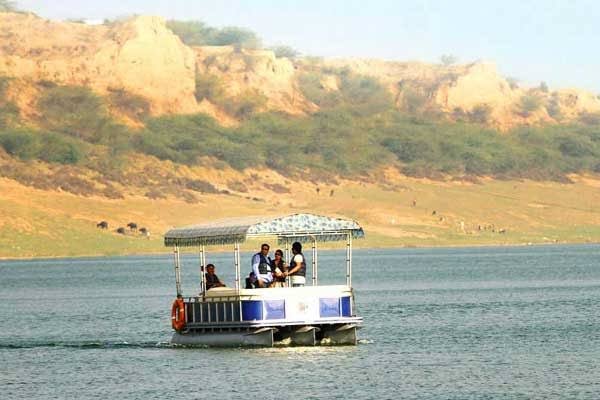
Everything about a Ranthambore safari is about ground: dry leaf litter, dust, engine noise, and the tension of scanning the scrub. The Chambal is the opposite. You are sitting low in a flat-bottomed motorboat on open water, the engine is idling or off, and the only movement is the current carrying you past sandbars where birds are sitting. People who find the forest stressful usually find this restful, and people who love birds often end up staying an extra day for it.
The trip leaves from Palighat, roughly 45 kilometres from Sawai Madhopur, at the northern end of the National Chambal Gharial Sanctuary. The river here is protected across three states — Rajasthan, Madhya Pradesh and Uttar Pradesh — which is unusual and the reason the wildlife is still present. It was protected in 1979, well before river conservation became common, and the result is a river that still runs remarkably clear and supports species that have disappeared from most Indian waterways.
The headline animal is the gharial, the long-snouted crocodilian with the bulbous nose at the tip of its nostrils. It is critically endangered, and the Chambal holds one of its last strongholds. You will more often see them lying still on a sandbar than moving, so patience and binoculars matter more here than a long lens.
What you are likely to see
Gharial
A critically endangered crocodilian with narrow jaws and a distinctive knob on its nose, for filtering fish at the surface. Basking in groups on the shallows.
Mugger Crocodile
The broad-snouted marsh crocodile, more common than the gharial and often sharing the same sandbar. Heavier-bodied, and it sits with its eyes on you.
Gangetic River Dolphin
A genuinely uncommon sighting in these deeper pools, most likely in the early morning. If one surfaces near the boat, treat it as a bonus.
Turtles
Several species hold on in these waters, including the Indian softshell and the roofed turtle, usually hauled out on logs and rocks to warm themselves.
Indian Skimmer
A striking riverbird with a long orange-and-black lower mandible, flying low over the water with its tip in the surface. Often in pairs on the sandbars.
Winter migrants
The sanctuary is a Ramsar site with over 300 recorded bird species. From November to March look for bar-headed geese, ospreys, plovers and sandpipers.
Practical details
- Boarding point: Palighat, about 45 km from Sawai Madhopur — roughly an hour by road
- Vessel: Flat-bottomed motorboat with a canopy, life jackets provided for everyone
- Duration: Around one hour on the water
- Rides: Several through the day, from about 8:00 AM to 5:00 PM
- Group size: Usually six to ten people per boat
- Price: Around ₹500 per person; children under five ride free
Book it in July and August
The single most useful thing about this trip is the calendar. Ranthambore closes for the monsoon from 1 July to 30 September, which is exactly when the Chambal is at its most rewarding: green banks, water birds, and mist lifting off the river at dawn. Plenty of guests use the closed season to stay in Sawai Madhopur, take the boat trip on a calm morning, and visit the fort and temples while the park is shut.
On the water
- Go early. The 8:00 AM ride has mist on the water, soft light, and the birds still feeding. It is the best ride of the day.
- Keep your voice down near the shallows. Gharials flush easily and the boatman will usually raise a hand to ask for quiet before he cuts the engine.
- Bring binoculars. A 8x42 pair shows you more than any camera lens at this distance, especially for the sandbar colonies.
- Do not feed anything. Feeding gharials or crocodiles is illegal and genuinely dangerous. The sanctuary depends on the animals behaving naturally.
- Wear the life jacket. Not one of us wants it. The water is deep in places and the season for strong currents is real.
- Stay seated while the boat is moving. The river is calm but the pontoons are low and slippery.